
THE CHRISTIAN FAITH
I. THE CREED
(return to list of contents)
The core of the Orthodox Christian faith is summarized in what is known as the Nicene-Constantinopolitan creed (commonly called the Nicene creed), which is recited in the liturgical services of the Orthodox churches. This creed was first developed and issued by the first ecumenical council (325 AD), and was expanded by the second ecumenical council (381 AD). This means that this creed was adopted by the one universal Church of the fourth century AD as the basis for the true Christian faith.
NICENE CREED
We believe in one God,
the Father Almighty,
maker of heaven and earth
and of all things visible and invisible.
And we believe in one Lord Jesus Christ,
the only-begotten Son of God,
begotten of the Father before all ages,
Light of Light,
true God of true God,
begotten, not made,
of one essence with the Father;
by whom all things were made;
who for us men and for our salvation
came down from heaven,
and was incarnate of the Holy Spirit and of the virgin Mary
and was made man;
and was crucified also for us under Pontius Pilate.
He suffered and was buried.
And the third day He rose again
according to the Scriptures
and ascended into heaven
and sits at the right hand of the Father.
And He will come again with glory to judge
both the living and the dead,
whose kingdom will have no end.
And we believe in the Holy Spirit,
the Lord and giver of life,
who proceeds from the Father,
who with the Father and the Son together
is worshiped and glorified,
who spoke by the prophets.
And we believe in one holy Christian and apostolic Church.
We acknowledge one Baptism for the remission of sins,
and we look for the resurrection of the dead
and the life of the world to come. Amen.
II. HIGHLIGHTS OF THE BASICS OF THE ORTHODOX CHRISTIAN FAITH
(return to list of contents)
A. The Holy Bible is inspired truth: “Your word is truth” (John 17: 17b).
B. The Holy Trinity.
C. The divinity of Christ.
D. The virgin birth of Christ;
His sinless life;
And his miracles.
E. Christ died for us.
F. The bodily resurrection of Christ from the dead, and his ascension to heaven.
G. The second coming of Christ in
power and glory to judge the living and the dead.
(return to list of contents)
The human soul is immortal by the grace of God. Physical death is the separation of the soul and the body. The Holy Bible distinguishes two states of the human soul after physical death: the state immediately following death, and that after the final General Judgment. Immediately after death, a Particular Judgment of each person takes place, after which the disembodied human soul enters an intermediate state either of spiritual bliss in the immediate presence of Christ with the angels and departed saints, or of torment and darkness separated from God. At that point the destiny of the departed person is fixed into eternity (Luke 16: 19-31). However, the person does not receive the full eternal reward or punishment until after the General Judgment.
The second coming of Christ, our Lord, will be in glory and power (Matthew 24: 30; Luke 21: 27). At this second coming, he will judge the living and the resurrected dead in the final General Judgment (Matthew 25: 31-46; Acts 10: 42; 17: 31; Revelations 22: 12). The General Judgment will occur right after the resurrection of all the dead (John 5: 28-29), at which time the soul is united with a resurrected body for eternity. Those who died in Christ will receive incorruptible spiritual bodies (1 Corinthians 15: 35-50). The eternal bliss is a spiritual bliss at a higher state of existence in the immediate presence of God. It will not be a materialistic carnal existence centered around gluttony, polygamy, and sensual pleasures.
H. The Church.
(return to list of contents)
The Church is the community of the Christian believers. It consists of the clergy, monks, and laity. It is the mystical body of Christ encompassing the faithful living and dead. Those Christians who have fallen asleep in Christ over the centuries constitute the invisible eternal heavenly part of the Church, the Church Triumphant. It is holy and entirely pure. The living Christians constitute the visible historical earthly part of the Church, the Church Militant. The earthly Church is the only passage to the heavenly Church.
The Church is a living divine-human organism in which Christ, the
head of the Church (Ephesians 1: 22-23; Colossians 1: 18), is united
with the believers, the body of the Church, without confusion (1 Corinthians
12: 12-13). Christ has established the Church through the Holy Spirit
at Pentecost (Acts 2: 1-4). The Holy Spirit of the living God builds up, animates and continually sanctifies the Church. Christ loves the Church (Ephesians 5: 25).
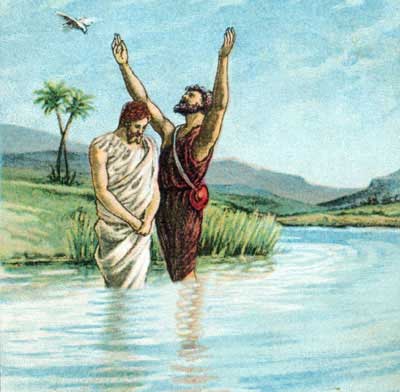
Joining the Church to begin the new life in Christ is by means of the new birth in Christ as manifested in Holy Baptism: “Jesus answered, ‘Most assuredly, I say to you, unless one is born of water and the Spirit, he cannot enter the kingdom of God’” (John 3: 5); "Go therefore and make disciples of all the nations, baptizing them in the name of the Father and the Son and the Holy Spirit" (Matthew 28: 19). Christ has instituted baptism as the rite of initiation into the Christian Church. It is required for entering the kingdom of heaven. In fact, Jesus himself was baptized by John the Baptist (Matthew 3: 13-17) in order to give us his example to follow, and to stress the importance of the Sacrament of baptism in our new life with him. A human soul that lives away from God is spiritually dead. The first resurrection of the human person begins with baptism, and then grows and develops through life in Christ. Martyrdom for the Christian faith before baptism is equal to the act of baptism, and is called the baptism of blood.
The purpose of the Church is the continuation of the redemptive sanctifying work of Christ through the Holy Spirit. It brings sinners to the way of holiness. There is no salvation outside the Church. A person cannot have God as his father if he does not have the Church as his mother. The Church is the light of the world and the salt of the Earth (Matthew 5: 13-16). It is the instrument for redemption in this world. The Church administers the sacraments. The Church models the new life. It gives examples of people who walk by the Holy Spirit with Christ. It provides encouragement and direction to live the new life in Christ and grow in sanctification in his likeness.
Some members of the earthly Church may be insincere, and are not being regenerated by the grace of God (Philippians 3: 18; Acts 5: 1-11). In the winter, living and dead trees appear to be alike. Likewise, in the earthly Church, the distinction between the sincere and the insincere remains unclear, to be revealed at the end of time. However, the earthly Church is pure in its doctrine and sacraments duly administered. Through her calling, destiny, patience and repentance, the earthly Church is being made holy.
I. The Sacraments of the Orthodox Church.
(return to list of contents)
The Orthodox Church believes in seven Sacraments. Three of them are not repeatable in the life of the believer: Baptism (new birth in Christ by washing of regeneration), Chrismation (the seal of the gift of the Holy Spirit), and Ordination. The remaining four may be repeated: Holy Eucharist (union with Christ and the Church), Repentance, Marriage, and Holy Unction (anointing the sick). The Sacraments originated in the early Church. Not all of them are explicitly described in the Scriptures.
The holy Mysteries (Sacraments) are administered by visible rites. They deliver invisible divine grace to the person who is properly prepared to receive them, thereby infusing God's life into the present age without confusion. The Sacraments are one of the main avenues of the operation of the grace of God to further the process of sanctification of the faithful by the Holy Spirit through the action of the Sacraments. The Sacraments are not mere symbols of spiritual realities. They transmit, not a picture or abstract representation, but the reality of their subject (e.g. in Eucharist, we actually have communion with the deified glorified Body and Blood of Christ). Through these means, the faithful actually participate in the life of Christ, and their dependence upon him is not symbolic, but very real.
The Holy Mysteries are transmitted by visible means, embodying spiritual realities in material form, as this corresponds to man's twofold nature (body and soul). In itself, the sacrament is an authentic grace-giving divine power. This efficacy of the Sacrament is dependent neither upon the faith or moral standing of the clergyman officiating it, nor upon its recipient. The Sacrament is the work of Christ by the power of the Holy Spirit. However, to be fully effective, the Sacrament requires the appropriate human response.
The incorporation of man into Christ and his union with God require cooperation of two unequal, but equally necessary forces: divine grace and human will. The holy Mysteries are neither magical nor mechanical operations. As the seed gives fourth according to the ground into which it was planted, so the full effectiveness of the Sacramental life is made manifest to a greater or lesser degree by the spiritual awareness, the faith and the devoutness of the participants.1
For the Sacraments to be operative, its ministers (bishops or priests) must be canonically ordained to conduct the rite of the particular Sacrament.

1Alkiviadis Calivas, "The Sacramental Life Of The Orthodox Church," A Companion to The Greek Orthodox Church, pp. 33-34.